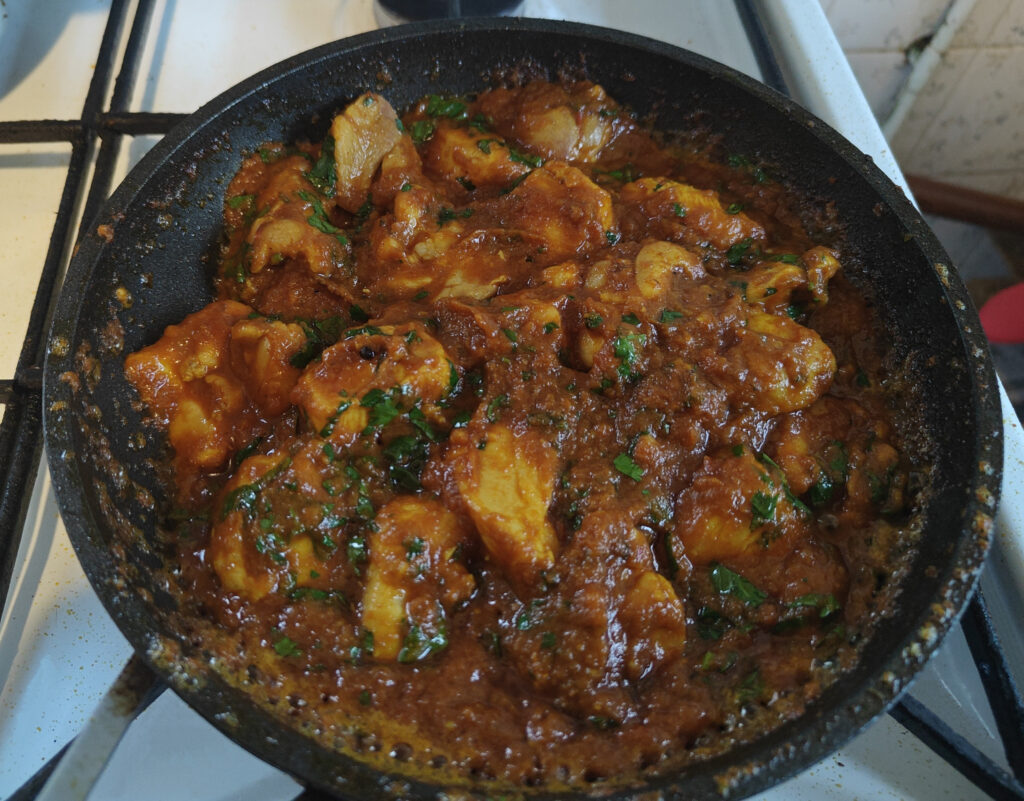
This is a complete update to the original article. I have found a much better way, thanks to YouTube and many other online sources.
My comment from the original article still stands: if you want to make a decent curry in the restaurant-style, you need to do it in stages, and make up a batch of basic curry gravy.
Please note that ‘restaurant-style’ does not mean you can’t whack up some beautiful-tasting dishes quickly from scratch. One of my Pakistani pupils gave me a recipe for lovely chicken and Okra ‘curry’. It was simple and reasonably quick to make, and when I made it, it tasted just like the stuff she used to bring me on lessons. It was authentic Pakistani home-cooking – relatively dry, using small pieces of chicken on the bone, and quite spicy, but it still tasted just right. After all, it’s the taste that matters.
However, with British Restaurant curry, the sauce is a vital part of the meal. And I have got a lot closer to nailing it the last year or so. Here’s my current recipe. The ingredients are similar to what I used in the previous version of this article, but the process is different, and much simpler.
In terms of timings, it takes little more than an hour to cook the masala, and about ten minutes to pre-cook the chicken (longer if you’re using lamb or mutton). Obviously, you have to prepare the ingredients as well, but you end up with between 6-14 portions that freeze well. It only takes about ten minutes to make a curry from the pre-prepared gravy and meat.
Basic Gravy/Masala
| Quantity | Ingredient |
|---|---|
| 6 | Large Onions |
| 2 | Peppers |
| 2 | Carrots |
| 500 mls | Rapeseed Oil (2 cups) |
| 2 | 400g cans Chopped Tomatoes |
| 8 tbsp | Garlic/Ginger puree |
| 10 | Green Chillies |
| 6 | Indian Bay Leaves* |
| 4 | Sticks Cassia Bark (each about 2 inches)* |
| 4 | Brown Cardamoms* |
| 6 | Green Cardamoms* |
| 1 tbsp | Salt† |
| 2 tbsp | Kashmiri Chilli Powder† |
| 2 tbsp | Turmeric Powder† |
| 2 tbsp | Coriander Powder† |
| 1 tbsp | Cumin Powder† |
| qs | Water |
Coarsely chop or slice the onions, peppers, and carrots. Cut the tops off the chillies, and slit them lengthways (leave the seeds in).
Heat the oil in a large pot on medium heat, then add the whole spices (marked with (*) in the list). Sizzle them for 30 seconds, then add the chopped onions. Stir frequently for about 20 minutes until the onions are soft and golden.
Add the garlic/ginger puree and chillies, stir frequently, and cook for a few minutes until the garlic becomes fragrant (if you use garlic a lot, you know the smell you are after). Just don’t let it stick or burn.
Add the dry spices (marked (†) in the list), and stir for a minute.
Add the two cans of tomatoes, and 500mls of warm/hot water, then stir everything together. Cover the pot and simmer for 45 minutes. Stir occasionally to make sure it isn’t sticking. The oil will rise to the surface near the end.
Turn off the heat and let it cool slightly. Take out the bay leaves and cassia pieces (and the cardamoms, if you can find them, but these don’t matter so much). Then use a stick blender to break everything up. It doesn’t need to be silky smooth (unless you really want it to be), so don’t overdo it. Just blend all the large bits of chopped vegetables into the sauce.
This is your curry gravy/masala.
I portion mine up using some rectangular silicone moulds I have, but you can use bags or any other watertight container, and freeze them. I then pop them out of the moulds and store them in a Ziploc bag. In my case, since I have gone big on portion control over the last few years, the recipe above produces around 14 portions of gravy/masala (for single servings). The photographs show a single portion being cooked (though in this case, I used a whole chicken breast). For family-sized portions, it makes 4-6 servings. There should be about 2kg of gravy/masala in total, and you can adjust it using hot water if it’s much less than this.
A single serving (approx 120g) comes in at around 350 kcals.
This gravy is not super-hot (in the spice sense), but it has a reasonable heat (I’d say it is ‘medium’), and works fine just as it is. You can fix the heat as necessary when you use it to make your curries, and modify the flavour using a spice mix/curry powder of your choice.
Pre-cooked Chicken
So I can make my meals quickly, I have now gone back to pre-cooking my meat most of the time. I used to do this years ago, but then I just drifted into using raw chicken (my preferred meat), since it cooks so quickly. However, if you’re using lamb, beef, and especially mutton, the cooking time for the raw meat is much longer. Pre-cooking makes a lot more sense with these, and even pre-cooked chicken makes producing the final curry a quick and simple affair.
| Quantity | Ingredient |
|---|---|
| 1.25 kg | Chicken |
| 2 | Large Onions |
| 3 tbsp | Rapeseed Oil |
| 5 | Brown Cardamoms* |
| 6-8 | Green Cardamoms* |
| 1 | Stick Cassia Bark (about 2 inches)* |
| 10 | Black Peppercorns* |
| 1 tsp | Cumin Seeds* |
| 4 | Indian Bay Leaves* |
| ½ tsp | Salt |
| 1 tsp | Turmeric |
| 1 | 400g can Chopped Tomatoes |
| qs | Water |
Chop the chicken into your desired dice. I prefer chicken breast cut into about one inch pieces, but go smaller if you wish. You can use boneless chicken thighs or bone-in meat if you want. I haven’t tried this with large pieces of bone-in meat, so you’re on your own with that. Mine is always diced to get something similar to what I have when I eat in a restaurant. Just remember the dice shrinks a bit when it is cooked, so be careful if you want very small pieces.
Coarsely chop the onions.
Heat the oil in a suitable pot, then fry the whole spices (marked with (*) in the list) for 30 seconds. Add the onions and salt, and stir.
Cook for about 10-15 minutes until onions are softened, then stir in the turmeric and cook for another minute or so.
Add the tomatoes, and cook for 10-15 minutes with frequent stirring.
Stir in the chicken dice and make sure it is coated with the sauce, then cover with warm/hot water. Bring to the boil, then simmer for ten minutes. Stir occasionally.
Turn off the heat and let it cool a little. Strain off the stock using a colander or sieve, but don’t throw it away. Pick out the chicken pieces and discard the onions and spices.
You can use the chicken immediately, or freeze it. When I’m freezing it, I pour everything into a colander over a large pan (keep the stock), and then pick out the chicken pieces and lay them on a tray. I put the tray in the freezer, and once the chicken is frozen I put the pieces into a bag so I can take out what I need when I’m cooking.
One single portion of pre-cooked chicken contains about 80 kcals.
Once the stock is cool, I use my rectangular silicone mould to freeze it into blocks, and then store these blocks in a separate bag. I typically get ten blocks of about 115g each, and each block contains approximately 40 kcals.
Remember that although chicken will cook in about ten minutes, lamb needs about an hour of simmering, and mutton is at least two hours. Taste a piece, and if it’s the right texture, it’s done and will work in your curry.
Making a Curry
This is for my own single portion for one person (as shown in the photographs).
| 1 portion | Gravy/Masala (defrosted) |
| 1 portion | Pre-cooked meat (defrosted) |
| 1 tbsp | Rapeseed Oil |
| 1 | Indian Bay Leaf* |
| ½ | Stick Cassia Bark* |
| 3 | Green Cardamoms* |
| 1 tbsp | Garlic/Ginger Puree |
| ½ tsp | Kashmiri Basaar or curry spice mix |
| 2 tbsp | Kasuri Methi |
| qs | Stock† |
| qs | Chopped Coriander |
The actual size of a ‘portion’ is up to you. The recipe here is one of my single portions, so about 200g of gravy/masala, and about 8 pieces of pre-cooked chicken (note that the photos are from my first batch, in which I used a whole chicken breast, so there is twice as much chicken as I use for a single portion most of the time).
Heat the oil in a pan, then add the whole spices (marked with (*) in the list), and fry for 30 seconds until sizzling. Note that you could also add a couple of cloves, and a pinch of cumin seeds at this stage.
Add the garlic/ginger puree and fry for 30 seconds, add the Basaar/curry blend and stir for 30 seconds, then add the gravy/masala. Stir, and bring to heat. If you want a hotter curry, you could add chopped or sliced chillies at this stage to make it as hot as you wish. If you’re after a Vindaloo-style curry, add half a tablespoon of vinegar here (more or less, as you desire).
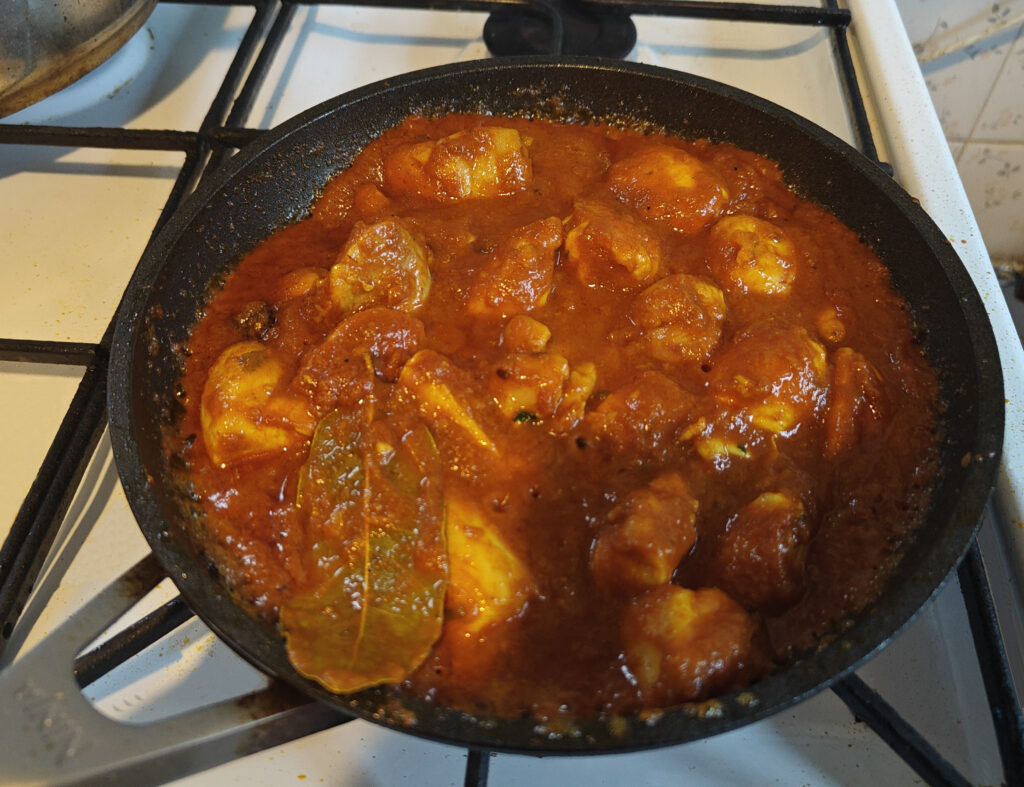
Add the pre-cooked meat, stir, and heat it through.
After a couple of minutes, rub the Methi hard between your hands and into the curry to break it up into a powder, and stir it in. Use some of the stock you saved from the pre-cooked meat (or just water, or even your own chicken stock or bouillon) to maintain your preferred consistency. Leave out the Methi, if you like. You could add cream or yoghurt at this stage and stir it in, since the curry is now almost finished.
Once the curry is boiling and of your desired consistency (ideally, with oil rising to the surface, but it’s up to you if you want a thinner gravy), stir in the chopped Coriander and remove from the heat.
This portion size contains about 600 kcals.
Serve with Basmati Rice, or just with chapattis or naan bread. Or do all of them – it’s up to you. Remember that there will be calories in these, so take that into account if you’re calorie counting.
If you are using raw chicken, after you fry the whole spices, add the chicken and keep stirring to prevent the spice burning, and seal it on all sides so there’s no pink. Then add the garlic/ginger and proceed from there. Raw chicken pieces take about 10 minutes to cook through.
Basmati Rice
I bought a rice cooker, and it is a game changer. Nothing fancy, just a small rice cooker.
You can easily cook rice in a saucepan, but you need to pay a lot of attention to it when you’re doing it. With a rice cooker, you just press ‘GO’ and it makes it. And it turns out perfectly.
| ½ cup | Basmati Rice |
| 1 cup | Water |
| ½ tsp | Salt |
| ½ inch | Cassia Bark |
| 3 | Green Cardamoms |
| 1 | Indian Bay Leaf |
| 2 | Cloves |
| 1 tsp | Rapeseed Oil |
Drizzle the oil into the rice cooker bowl and add the spices and salt.
Measure out the rice. If you want, you can wash it, then soak it for 30 minutes in cold water, but this isn’t essential – especially if you use Tilda rice. Other rice brands might be more starchy, making washing/soaking more important.
Add the water, put the lid on, and set it to the cook cycle. Let it do its thing.
This is pretty much a single portion, and contains about 460 kcals.
Why do you use so much oil?
You can’t make a decent curry without oil. Sure, you can make something – but it isn’t a recognised curry. The spices depend on the oil to disperse properly (and taste right). The essential oils in spices which give them their flavours only dissolve in oil, so you need it to get the proper taste.
Having said that, the batch of gravy/masala I made above is enough for about 14 single portions, so the 500mls of oil in the recipe comes down to 35mls per portion – and that is about 300 kcals. So you are not really ‘using’ a lot of oil in the sense that you’re eating it in a single sitting – you are batch cooking. Since I have used Rapeseed Oil (Canola in other countries), it is a healthy oil (mine is cold-pressed from UK crops anyway, and has no additives, though I realise GMO is an issue elsewhere).
If you really are so wound up about oil, you can reduce the amount in the gravy/masala recipe from two cups (500mls) to one cup (250mls), and that will reduce the calorific value of a single portion from 350 kcals to about 200 kcals.
Can you use another oil?
Peanut/Groundnut oil also works. You could also get away with Sunflower oil, and certainly with the generic ‘cooking oil’ you can buy from Asian stores (though be aware it is refined and contains additives). Don’t use Olive Oil, because it tastes like Olive Oil! And if you’ve read somewhere that an obscure oil from a new plant found in the depths of The Amazon is better than anything else in the world, ever, then that is also up to you. You need a neutral oil – one which doesn’t have a strong flavour. I use Rapeseed Oil.
What if I want bigger batches?
You’ll have to work it out from what I have written here. Curry is quite forgiving, but you can overdo it with spices. Chilli doesn’t just equate to double if you double the batch size. However, even if you do double it, it’ll just maybe be a bit too spicy, so you’ll know what to do the next time.
How do I drain excess oil from curry?
Just let it stand while it’s hot and the oil will rise to the surface. Then you can either pour it off, or use a spoon to remove it a bit at a time.
My advice is not to remove too much – curry isn’t curry without some oil (and that also applies to salt).